





SAP Best Practices: A Smarter Way to Implement S4HANA
What Makes Implementation Complex—And How to Simplify It
Enterprise software implementations often become multi-year projects that consume budgets and test organizational patience. Custom configurations pile up, testing cycles extend indefinitely, and go-live dates keep shifting.
There’s a better approach. SAP provides pre-configured, industry-tested solutions that address 70-80% of standard business requirements out of the box. These frameworks—known collectively as SAP best practices—reduce complexity, accelerate deployment, and lower implementation risk significantly.
Key Takeaways for Leadership
Metric | Impact |
Implementation Speed | 30-40% faster time-to-value |
Risk Reduction | Proven processes tested across hundreds of deployments |
TCO Savings | Lower maintenance costs through clean-core architecture |
Upgrade Readiness | Standard configurations enable seamless quarterly updates |
Business Focus | Teams spend time on differentiation, not rebuilding standard processes |
Understanding Pre-Configured Solutions
Think of these as tested blueprints rather than blank canvases. SAP has documented thousands of successful implementations across industries and distilled that knowledge into ready-to-deploy packages.
What’s included:
- • Baseline configuration settings
- • Standard business process flows
- • Role-based security templates
- • Integration patterns for common scenarios
Manufacturing companies find production planning workflows already configured. Financial services organizations get compliance-ready accounting structures. Retail operations receive inventory and point-of-sale integration frameworks.
Core Components Available
Industry-Specific Process Templates
Manufacturing requires different workflows than retail or professional services. Pre-built templates address these variations directly.
Examples:
- • Discrete manufacturing: Bill-of-material management, routing, work center configuration
- • Process industries: Batch management, recipe handling, quality inspection frameworks
- • Retail: Merchandise planning, omnichannel fulfillment, promotional pricing
These aren’t theoretical models—they reflect actual production environments from successful deployments.
Country-Specific Legal Requirements
Tax calculations, social insurance, payroll structures, and financial reporting vary dramatically by jurisdiction. Localization packages handle these complexities automatically.
Coverage includes:
- • German split valuation and chart of accounts
- • Indian GST configuration and statutory reporting
- • US GAAP and SEC compliance frameworks
- • EU GDPR and data residency requirements
Compliance becomes built-in rather than custom-developed.
Role-Based Access Models
Security shouldn’t start from scratch. Pre-defined role templates cover common organizational structures:
- • Production planners
- • Warehouse supervisors
- • Financial controllers
- • Purchasing managers
- • Quality engineers
Authorization objects are already assigned based on job responsibilities. Teams customize from working models rather than building authorization concepts from zero.
Deployment Accelerators That Drive Speed
SAP Activate Methodology
This agile framework guides projects from discovery through go-live and beyond. Phased deliverables replace big-bang approaches. Business validation happens iteratively, catching issues early when they’re cheaper to fix.
Activate delivers:
- • Sprint-based implementation cycles
- • Pre-built project task lists
- • Risk mitigation decision trees
- • Go-live readiness assessments
Model Company Configurations
SAP maintains fully configured reference systems for major industries. Rather than configuring from empty clients, implementations start with working systems that demonstrate end-to-end processes.
Value proposition:
Teams see how production planning triggers material procurement, which creates financial postings, which updates profitability analysis—all connected and functional. This visibility prevents the “how does it all fit together” confusion.
SAP Best Practices Explorer
This online library provides searchable access to thousands of process definitions, configuration guides, and testing scripts.
When you need it:
- • Configuring make-to-order production
- • Setting up intercompany transactions
- • Implementing quality management workflows
- • Designing warehouse slotting strategies
Documentation exists before you need it, not after struggling to figure things out.
The Fit-to-Standard Philosophy
Traditional implementations often started with “how do we make SAP work exactly like our current processes?” This led to heavy customization, extended timelines, and maintenance nightmares.
Modern approaches flip this question: “How can we adopt proven processes that already work?”
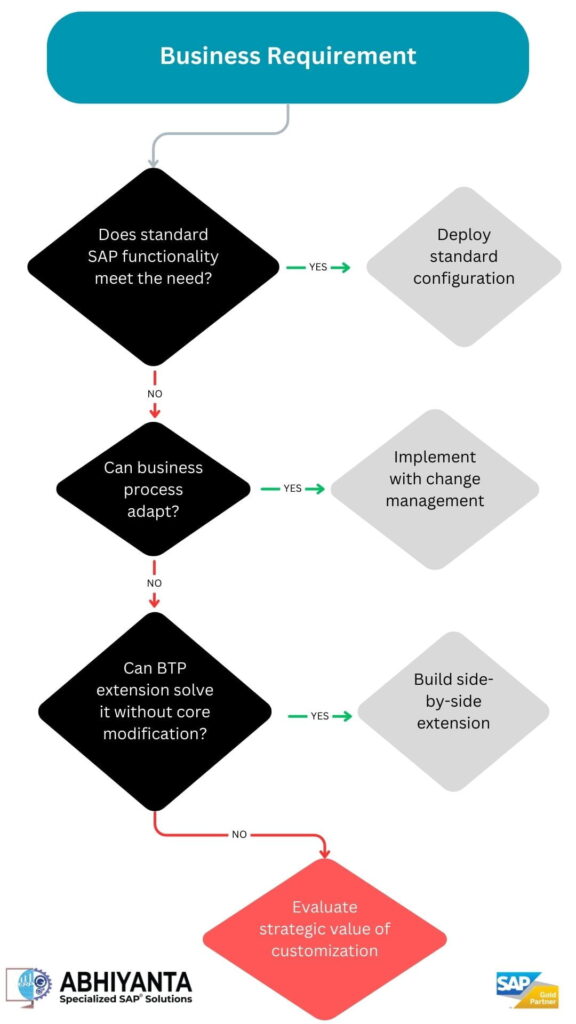
This clean-core approach keeps systems upgrade-ready and significantly reduces long-term maintenance costs.
Measuring Real Benefits
Faster Time-to-Value
Implementations using pre-configured solutions typically complete 30-40% faster than custom-built projects. Manufacturing companies go live in 6-9 months instead of 18-24 months.
Lower Implementation Risk
Proven processes have been tested across hundreds of companies. Edge cases are already handled. Integration points are validated.
Reduced Total Cost of Ownership
Less custom code means lower maintenance burden. Quarterly SAP innovation updates apply cleanly without breaking customizations.
Simplified System Maintenance
Standard configurations are easier to troubleshoot, document, and transfer to new team members. Knowledge doesn’t become trapped with a few “super users.”
When Customization Still Makes Sense
Standard solutions cover common requirements exceptionally well. However, some scenarios genuinely require tailored approaches:
Justified customization scenarios:
- • Regulatory requirements unique to specific industries
- • Competitive differentiation through proprietary processes
- • Complex integrations with specialized equipment
- • Legacy system bridges during phased transitions
Key principle: Distinguish between “must customize” and “prefer to customize” scenarios. Many requirements that initially seem unique actually fit standard processes when examined closely.
Clean Core Architecture Explained
Modern SAP implementations maintain separation between standard functionality and custom extensions:
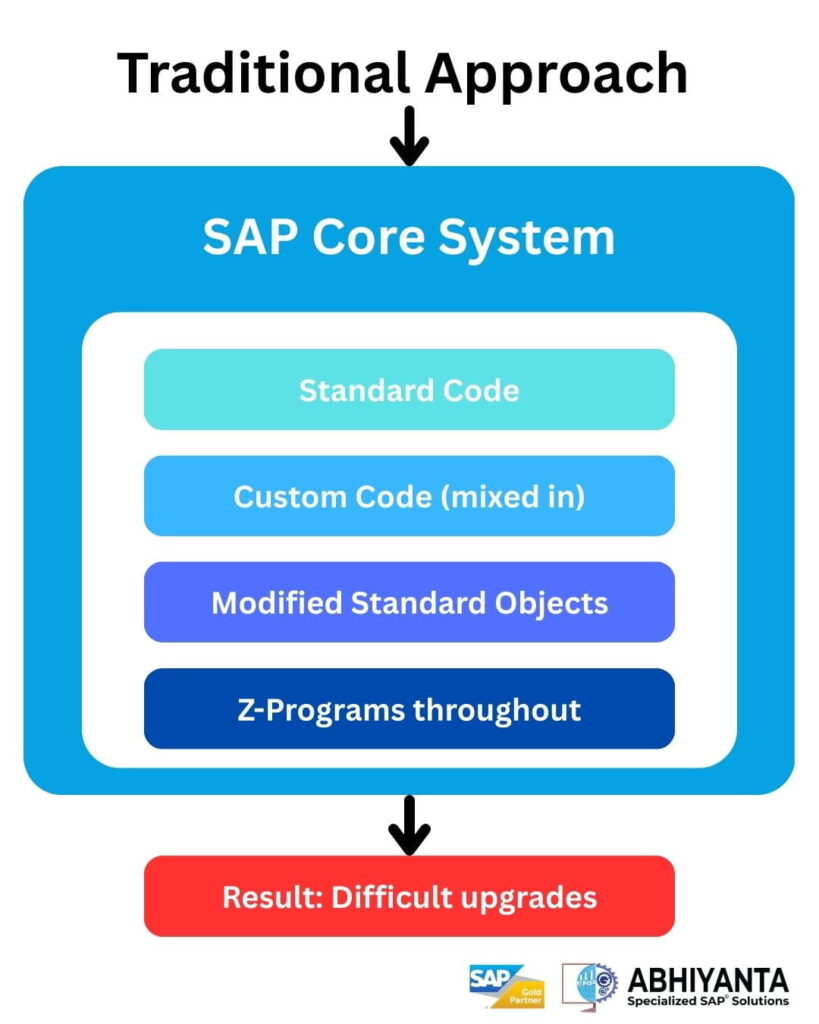
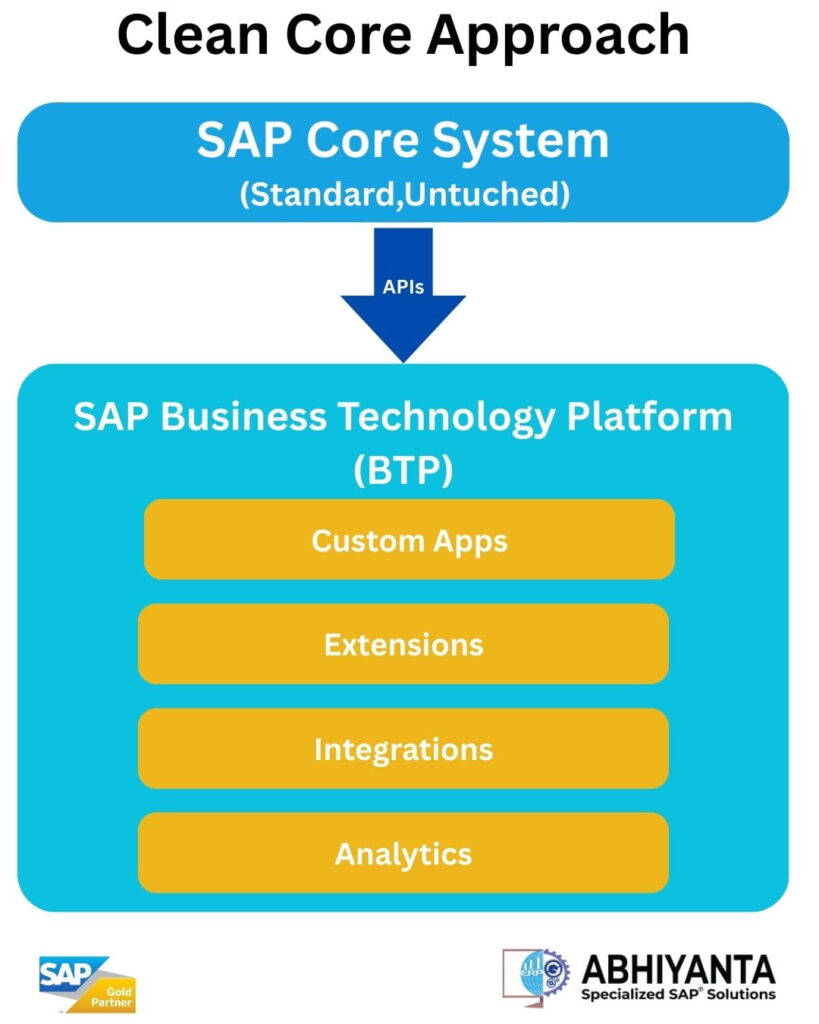
Business Impact: Systems remain upgrade-ready. New SAP innovations deploy quickly. Maintenance costs stay predictable.
Building Your Implementation Strategy
1. Assessment Phase
Document current-state processes and pain points. Map them against available standard solutions before assuming customization is necessary.
Typical finding: 80% of requirements align with pre-configured options.
2. Gap Analysis
For genuine gaps between standard functionality and business needs, evaluate alternatives systematically:
- • Can business processes adjust?
- • Can BTP extensions address it?
- • Is core customization truly necessary?
3. Proof of Concept
Deploy Model Company environments to let business users experience standard processes hands-on. This builds understanding and often reveals that standard approaches work better than expected.
4. Phased Rollout
Implement core processes first using standard configurations. Add complexity incrementally based on actual business needs rather than theoretical requirements.
Industry-Specific Advantages
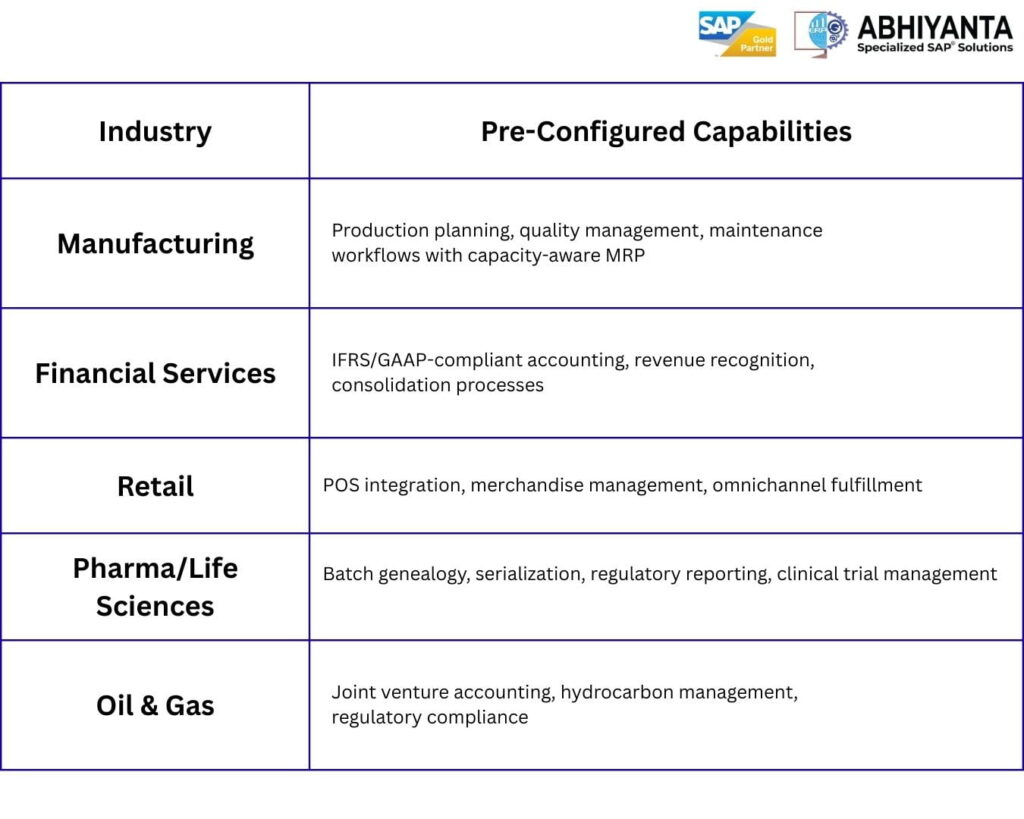
These vertical solutions represent decades of accumulated industry expertise
Governance Considerations
Success requires disciplined change management:
Establish clear criteria:
- • What business value justifies customization investment?
- • What’s the 5-year maintenance cost projection?
- • Does this request represent a training opportunity instead?
Create decision frameworks:
Make customization trade-offs visible to business stakeholders so they understand full implications.
Maintain documentation:
Even standard solutions need institutional knowledge about why specific options were chosen and how they support business processes.
Long-Term Value Creation
Organizations that embrace proven configurations position themselves for continuous innovation. When SAP releases new capabilities—embedded AI, sustainability reporting, advanced analytics—systems can adopt them quickly because core functionality remains standard.
Compounding benefits over time:
- • Faster ECC to S4HANA migrations
- • Smoother cloud transitions
- • Rapid integration with Ariba, SuccessFactors, Analytics Cloud
- • Lower technical debt accumulation
Systems that started with standard configurations remain flexible and responsive years later, while heavily customized systems become increasingly rigid over time.
Practical Next Steps
Immediate actions:
- 1. Evaluate your current SAP landscape against available standard solutions
- 2. Identify customizations that might not deliver proportional value anymore
- 3. Review pending enhancement requests through the fit-to-standard lens
For new implementations:
- • Start planning with Model Company demonstrations
- • Let business stakeholders see working processes before designing alternatives
- • Invest in training teams on standard functionality
For S4HANA migrations:
- • Use transition as an opportunity to shed technical debt
- • Map custom code to standard S4HANA equivalents
- • Design clean-core architecture from day one
Frequently Asked Questions
Yes, but strategically. During ECC to S4HANA migrations, organizations often use selective data transition to keep critical customizations while adopting SAP best practices for standard processes. The goal is reducing technical debt over time—not eliminating all custom code immediately. Prioritize SAP best practices for non-differentiating processes like financial close, procurement, and inventory management, while maintaining custom logic only where it delivers genuine competitive advantage.
SAP best practices scale to companies of all sizes. SAP offers different packages—SAP S/4HANA Cloud Public Edition includes SAP best practices specifically designed for mid-market organizations with 50-500 users. Small manufacturers benefit even more from pre-configured solutions because they typically lack large IT teams to build custom functionality. Implementation partners can activate only relevant SAP best practices modules based on your production complexity and user count.
SAP maintains country-specific SAP best practices localization packages for 100+ countries, including emerging markets across Asia, Africa, and Latin America. These packages address local tax codes, statutory reporting formats, labor laws, and banking integration standards. If your country’s regulations aren’t fully covered, SAP best practices provide the closest framework, with BTP extensions handling gaps without core modifications. Partner networks in regional markets often maintain additional localization accelerators.
Absolutely. SAP best practices Model Company systems let you explore fully configured environments before making decisions. Request access through your SAP account team or implementation partner to test industry-specific SAP best practices workflows hands-on. Many organizations run 4-6 week proof-of-concept phases where business users validate that SAP best practices processes meet 70-80% of their requirements. This evidence-based approach prevents over-customization and builds stakeholder confidence before project kickoff.
Making It Happen
The difference between successful implementations and prolonged struggles often comes down to strategic discipline. Teams that resist unnecessary customization, embrace proven processes, and maintain clean architectures deliver value faster and sustain that value longer.
Business leaders must distinguish between “how we’ve always done it” and “how it genuinely needs to work.” Technical teams need to challenge build-first instincts when adopting standard options exist.
Change management becomes critical. Users comfortable with old processes will initially resist new approaches, even when those new approaches are objectively better. Clear communication about why standardization matters helps smooth this transition.
Ready to leverage proven frameworks for your SAP transformation?
Abhiyanta International Solutions helps organizations assess customization portfolios, design fit-to-standard roadmaps, and implement SAP solutions using industry best practices. Explore our approach →