





What Is SAP RPT? A Practical Explanation for Manufacturing Businesses
What Is SAP-RPT?
SAP-RPT stands for Relational Pretrained Transformer. It is an AI foundation model developed by SAP research to make predictions from structured business data.
Unlike conversational AI tools designed to generate text, SAP-RPT works with tables containing rows, columns, numerical values, and categories. It can predict a missing category or estimate a numerical value using patterns in historical example records.
For example, a manufacturer could explore using SAP-RPT to estimate delivery delays, classify supplier risks, or predict material demand.
How Does SAP-RPT Work?
SAP-RPT uses a technique called in-context learning. Instead of training a custom model for every prediction task, an application supplies relevant historical records alongside the record requiring a prediction.
The model analyzes the relationships across the supplied data and returns a predicted outcome.
The basic workflow is:
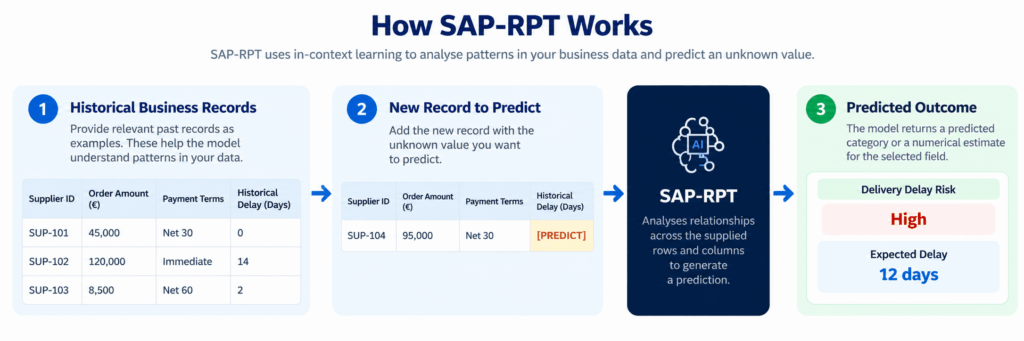
This approach removes the need for custom model training for each task. Data preparation, integration, and validation are still necessary.
Understanding SAP-RPT Model Versions
SAP-RPT is available in different model versions designed for different data volumes and prediction requirements. The choice affects how many historical records and data columns the model can process, as well as the trade-offs between speed, complexity, and prediction quality.
For example, SAP’s SAP-RPT 1.6 models have these limits:
Model version | Maximum historical context | Maximum columns |
SAP-RPT 1.6 | 2,048 rows | 100 |
SAP-RPT 1.6 Large | 65,536 rows | 256 |
These are maximum input limits, not recommended targets for every use case. SAP recommends starting with the data and complexity of the prediction task when choosing a model.
The Large version is intended for more complex prediction scenarios and larger datasets. It also offers Default Context and Deep Context modes, with Deep Context designed for scenarios that need to use larger amounts of historical data.
The right choice depends on your dataset, prediction requirements, response-time expectations, and cost considerations.
Want to compare the available versions? Explore the SAP AI Core Calculator to review the model options and their specifications.
Note: Model availability can vary by region and deployment setup.
Where Can SAP-RPT Help in Manufacturing?
1. Procurement
Historical supplier performance, order values, and material prices can provide context for exploring price predictions or supplier-risk classification.
2. Inventory Planning
Historical demand, stock movements, and lead-time records can support demand estimation and inventory-related prediction scenarios.
3. Supply Chain
Supplier history and purchase-order data can help explore predictions about delivery delays and potential supply risks.
4. Finance
Structured invoice records can support classification tasks, such as recommending General Ledger account assignments.
These are potential applications. Their usefulness depends on the quality and relevance of the available data, and each use case requires validation.
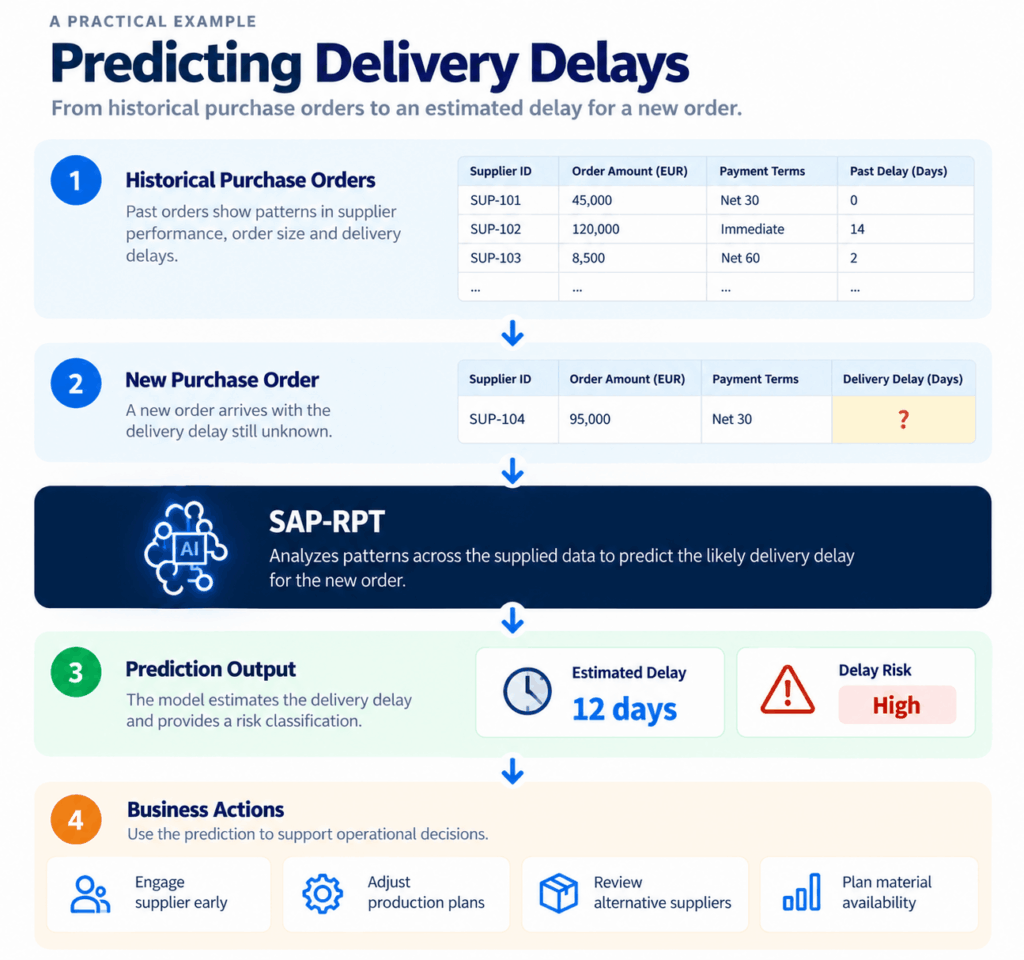
A Practical Example: Predicting Delivery Delays
Consider a manufacturer with historical purchase orders containing supplier IDs, order amounts, payment terms, and previous delivery delays.
A new purchase order arrives. The team wants to estimate its likely delay duration.
The application supplies representative historical records and the new order to SAP-RPT. The model returns a prediction based on the patterns it identifies.
The business can then evaluate whether the prediction is useful for supplier follow-up, production planning, or procurement decisions.
A prediction is not a guarantee. The model’s output must be tested against actual business outcomes before it is used to guide operational decisions.
Does SAP-RPT Require Custom Model Training?
No. SAP-RPT is already pretrained by SAP, so your project team does not need to train a new model for every prediction task.
However, production use requires appropriate SAP BTP services and entitlements, along with data preparation, security review, integration, and testing.
Businesses can begin by exploring a suitable use case in the SAP-RPT Playground before planning a production implementation.
SAP-RPT: Start With the Business Problem
SAP-RPT is designed for a specific purpose: predicting categories and numerical values from structured business data.
For manufacturing businesses, its potential value lies in exploring how existing ERP records could support better-informed decisions across procurement, inventory, supply chain, and finance.
The practical starting point is simple: identify a business outcome worth predicting, assess the available historical data, and validate whether SAP-RPT can produce useful results before scaling the solution.