





A Practical Guide: How to Prepare Your Business for a Smooth SAP S4HANA Migration
With SAP phasing out mainstream support for SAP ECC by 2027, businesses worldwide are feeling the pressure to plan their SAP S4HANA migration. However, it’s a transformative opportunity to streamline operations, unlock real-time analytics, and future-proof your enterprise. In fact, a 2024 SAP study revealed that 80% of organizations migrating to S4HANA reported a 20% reduction in operational costs within the first year, while global retailers like Unilever have used it to cut financial closing times by 50%.
Despite these benefits, a successful migration requires meticulous preparation to avoid costly delays or disruptions. This guide provides a step-by-step roadmap to prepare your business for a seamless transition. From data cleansing to stakeholder engagement, we’ll cover the critical steps needed to ensure your SAP S4HANA migration delivers maximum value.
Why Migrate to SAP S4HANA?
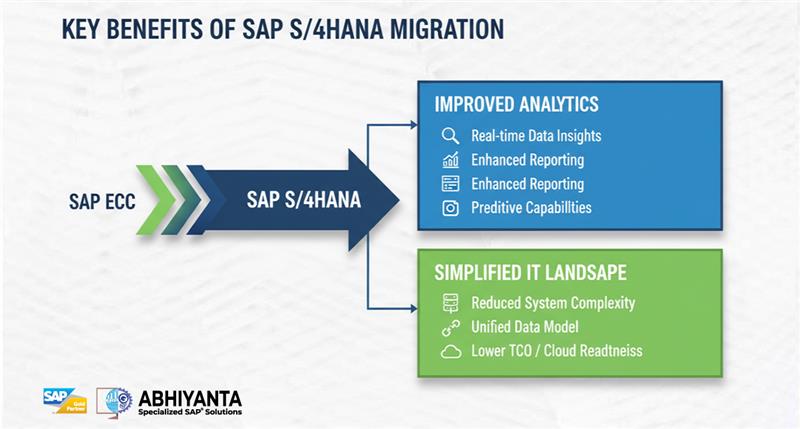
Ultimately, an SAP S4HANA migration offers game-changing benefits that position your business for long-term success. It delivers improved performance, as the HANA in-memory database enables faster transactions and real-time reporting. In addition, it creates a simplified IT landscape with a reduced data footprint, which lowers complexity and maintenance costs. Consequently, this empowers advanced analytics, allowing for data-driven decisions across all operations. These advantages ensure future readiness, keeping your system on the cutting edge with continuous innovation from SAP.
Key Phases of an SAP S4HANA Migration
A structured approach is essential for a smooth migration. Therefore, you should follow these essential phases to ensure success.
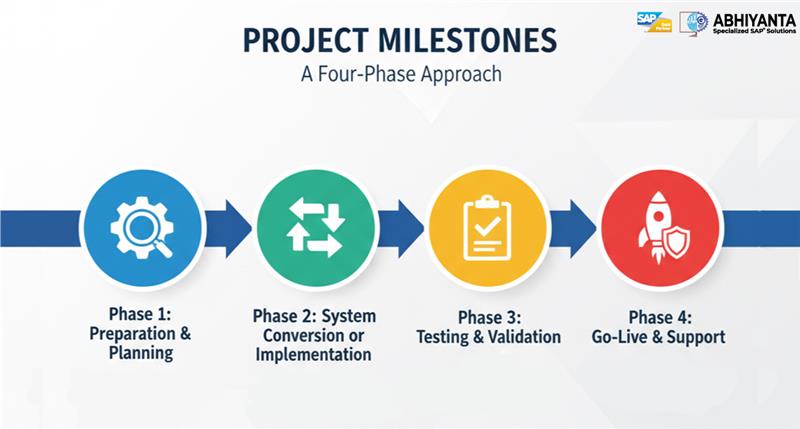
Phase 1: Preparation & Planning
First, you must build a strong foundation by assessing your current system and defining clear objectives. This involves using tools like the SAP Readiness Check to evaluate your landscape’s complexity, aligning the migration with measurable business goals like faster financial reporting, and identifying any infrastructure or data gaps early in the process.
Phase 2: System Conversion or Implementation
This phase focuses on the core technical preparation of the system. A key step is to clean up custom code, using SAP’s tools to identify and retire obsolete programs. It is also crucial to address data quality by standardizing formats and removing duplicates to ensure integrity before moving forward. Finally, all configurations should be validated by running trials in sandbox environments.
Phase 3: Testing & Validation
Thorough testing is non-negotiable, as it minimizes risks before the final cutover. This includes functional and integration testing to verify that all business processes and third-party systems work seamlessly together. Next, you should conduct User Acceptance Testing (UAT), engaging end-users to confirm the system meets their daily business needs. Lastly, performance testing confirms the system can effectively handle peak transaction loads.
Phase 4: Go-Live & Support
The final phase involves executing a flawless transition to the new system. You will follow a detailed cutover plan to migrate data into the new production environment. After going live, it’s important to actively monitor system performance and resolve any emerging issues promptly. Furthermore, providing hands-on end-user training and dedicated hypercare support is essential for ensuring strong user adoption.
Need help planning your migration? Our certified SAP consultants can guide you every step of the way.
Critical Preparations for a Successful Migration
To ensure a smooth transition, it’s important to focus on several key areas of preparation.
1 . Data Preparation
High-quality data is the backbone of S4HANA’s powerful analytics capabilities. The process begins with assessing and cleansing your data sources to remove duplicates and standardize formats. Next, you must map and transform legacy data structures to align with S4HANA’s new schema. It’s also crucial to securely back up databases and archive historical data before conducting test migrations to validate accuracy. A useful pro tip is to use tools like SAP Data Services or Master Data Governance (MDG) to streamline this process.
2. Custom Code and Integration
Legacy customizations and third-party systems can significantly complicate a migration. First, inventory all custom scripts and extensions and then use SAP’s ABAP Test Cockpit (ATC) to identify any code that is incompatible with S4HANA. In parallel, you must document all system integrations and analyze which connection points will be affected by the migration. Finally, be sure to refactor critical code and test all connectivity in a sandbox environment before go-live.
Overcoming Common Migration Challenges
Even well-planned migrations can face hurdles. A common challenge is choosing the right migration approach—Greenfield, Brownfield, or Hybrid. To solve this, you should conduct a readiness analysis using the SAP Transformation Navigator to align your choice with business goals. Another frequent hurdle is poor data quality in legacy systems. The solution is to start data profiling early and establish clear data governance to migrate only clean, relevant data. Finally, many businesses face budget overruns, so it is important to build a realistic business case and consider options like RISE with SAP for a more predictable, subscription-based model.
For more tips, check out the SAP Community post on understanding SAP Fiori to learn how to replace obsolete customizations with standard apps.
Final Advice: Transform, Don’t Just Migrate
An SAP S4HANA migration is more than a technical upgrade—it’s a chance to reimagine your business. To ensure success, start with a clear vision and define measurable outcomes from the beginning. Prioritize clean, harmonized data, as this is critical for S4HANA’s analytics. It’s also vital to engage stakeholders early to ensure alignment and simplify processes by eliminating complexity wherever possible. By treating S4HANA as a business transformation, you can unlock its full potential and build a future-ready enterprise.
Ready to embark on your S4HANA journey? Contact our SAP experts today to create a customized roadmap for your business.d

Mahesh Bachhav
Project Manager